
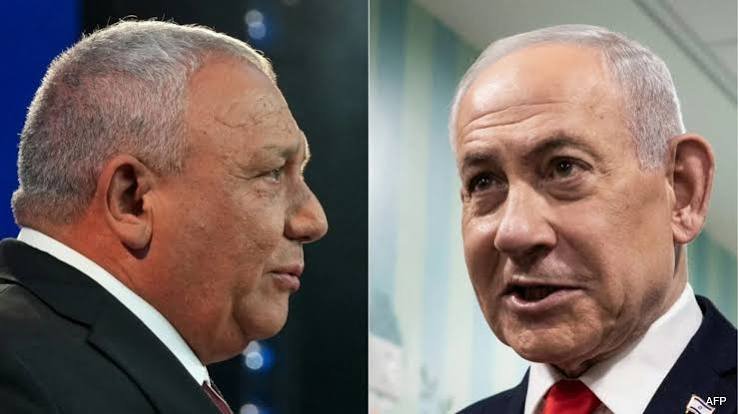
Former Israeli military chief Gadi Eisenkot has invited Prime Minister Benjamin Netanyahu’s Likud party for fresh coalition negotiations in an attempt to break the political deadlock and form Israel’s next government following the inconclusive October general election.
Eisenkot’s centrist Yashar party announced on Saturday that negotiations with Likud would begin on Sunday, November 22, describing the initiative as a genuine effort to establish the broadest possible governing coalition.
The move comes as Eisenkot faces considerable political and parliamentary challenges in assembling a majority in the 120-member Knesset, Israel’s parliament. Neither his opposition alliance nor Netanyahu’s right-wing coalition secured enough seats to govern independently.
According to the announcement, Eisenkot has instructed his negotiating team to pursue intensive discussions with Likud, leaving open the possibility of a national unity government involving political rivals.
However, the negotiations do not necessarily mean Eisenkot is prepared to serve under Netanyahu. He has previously ruled out joining a government headed by the incumbent prime minister, while remaining open to including members of Likud in an alternative administration.
Netanyahu and Eisenkot face parliamentary arithmetic
The October 27 election produced a fragmented parliament, with the following distribution:
| Political grouping | Knesset seats |
|---|---|
| Netanyahu’s Likud-led coalition | 53 |
| Eisenkot’s Yashar-led alliance | 48 |
| Arab-led parties | 19 |
| Total | 120 |
Neither political camp has the 61 seats required for a parliamentary majority.
Eisenkot therefore faces three difficult options: negotiate with Netanyahu’s Likud, secure support from Arab-led parties, or persuade ultra-Orthodox parties to join his coalition. Each option presents significant political and ideological obstacles.
Bennett backs Eisenkot-led unity government
The coalition negotiations have exposed differences within Eisenkot’s opposition alliance.
Former prime minister Naftali Bennett publicly backed the formation of a national unity government headed by Eisenkot, while ruling out joining Netanyahu’s government or political bloc.
Bennett’s position is significant because his political support is important to Eisenkot’s efforts to maintain the opposition alliance.
According to The Times of Israel, Bennett reaffirmed his commitment to replacing Netanyahu and supported negotiations with Likud only if they could produce a unity government under Eisenkot’s leadership.
Other opposition figures, including Avigdor Lieberman and Yair Golan, have their own political priorities, making consensus on coalition arrangements difficult.
Likud sets conditions for unity negotiations
Netanyahu’s Likud party has also outlined conditions for participating in a potential unity government.
These reportedly include ending political boycotts of Netanyahu and members of his government, as well as halting personal attacks and incitement against them.
The central disagreement remains the leadership of a possible coalition. Netanyahu has advocated a national unity arrangement, arguing that Israel requires a broad-based government to address its security challenges. Eisenkot’s camp, however, has campaigned on ending Netanyahu’s premiership.
December deadline adds pressure
Eisenkot has until December 6 to form a government under the mandate granted by President Isaac Herzog. He can seek an additional 14 days, potentially extending the deadline to December 20.
If Eisenkot fails, Netanyahu could receive an opportunity to assemble a parliamentary majority. Failure by both leaders could eventually lead to another general election.
Eisenkot has indicated that he does not intend to prolong negotiations indefinitely and has also considered presenting a minority national emergency government for a parliamentary vote if efforts to establish a broader coalition fail.
The latest negotiations represent an important test of whether Israel’s deeply divided political leadership can reach a compromise after the October election. While Eisenkot is attempting to bring Likud into a broader political arrangement, the question of who will become prime minister remains the biggest obstacle to forming a new government.