

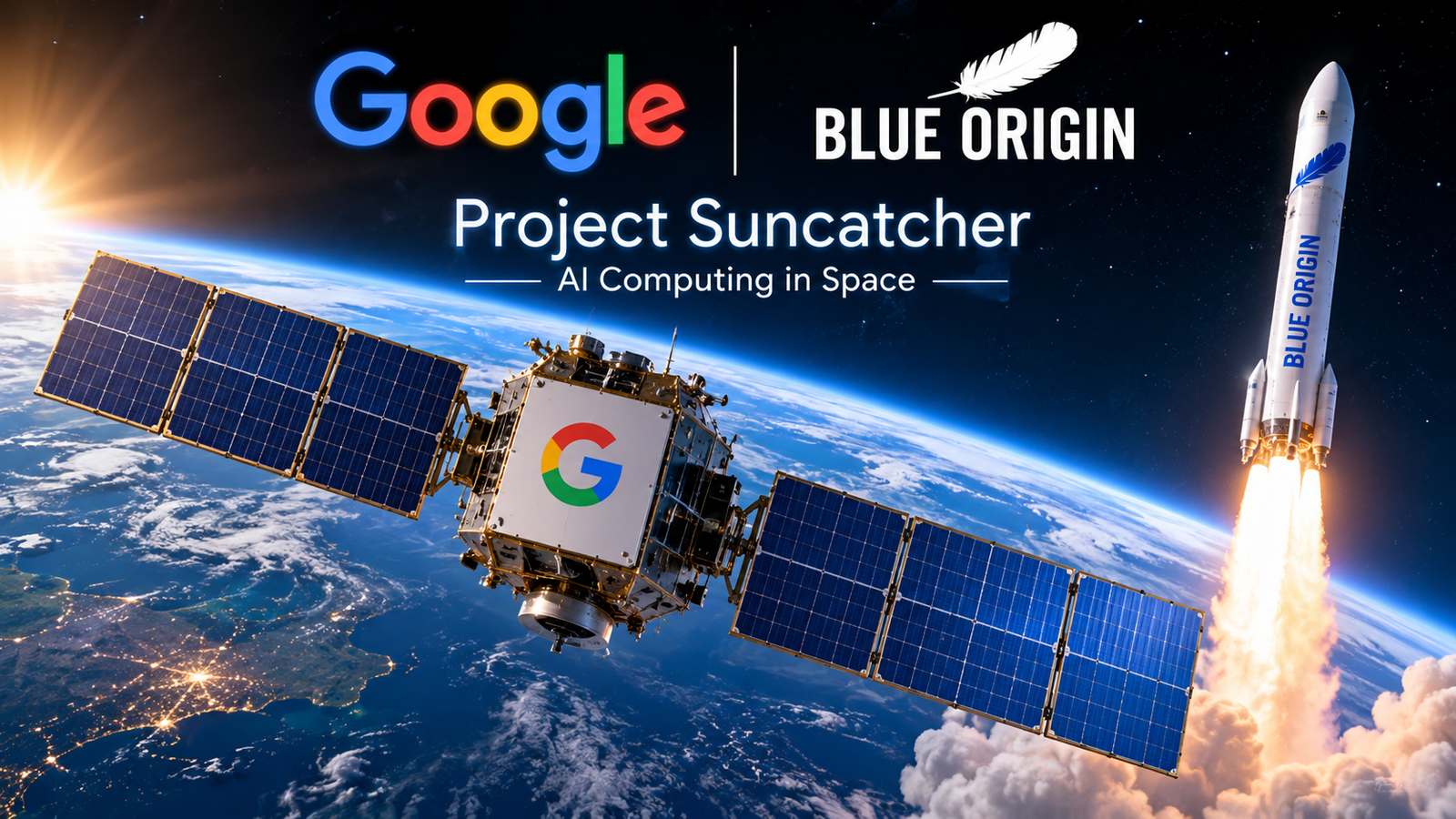
Project Suncatcher aims to explore whether artificial intelligence infrastructure can operate in space using abundant solar energy.
Artificial intelligence is rapidly transforming industries, scientific research and everyday life. However, behind the growing capabilities of AI systems lies an increasingly important challenge: the enormous amount of electricity and infrastructure required to operate them.
As companies continue developing more powerful AI models, demand for computing resources is placing additional pressure on data centres, electricity networks and cooling systems.
Google is now exploring a potentially unconventional solution — moving some of its AI computing infrastructure beyond Earth.
On November 19, 2026, Google announced a partnership with Jeff Bezos’ aerospace company Blue Origin to support its ambitious Project Suncatcher initiative. The collaboration will involve launching experimental satellites designed to explore the possibility of operating AI computing systems in orbit.
The first dedicated heavy-lift launch is targeted for the first quarter of 2029, using Blue Origin’s New Glenn rocket.
What Is Project Suncatcher?
Project Suncatcher is Google’s long-term research initiative aimed at developing space-based computing infrastructure.
The concept involves placing specialized computing satellites into orbit, where they could take advantage of abundant solar energy.
Unlike conventional data centres, which require extensive land, electricity distribution systems and cooling infrastructure, satellites operating in suitable orbits could receive sunlight for much of their operating time.
Google intends to investigate whether this approach could eventually provide a more scalable way to support the growing computing requirements of artificial intelligence.
The planned satellites will carry Google’s Tensor Processing Units (TPUs), specialized processors designed to accelerate machine-learning workloads.
According to Google, each satellite is intended to provide computing capacity comparable to a rack of conventional data-centre servers.
Why Move AI Data Centres Into Space?
The rapid expansion of artificial intelligence has created unprecedented demand for computing power.
Training and operating advanced AI systems requires powerful processors, substantial electricity and sophisticated cooling systems.
On Earth, these requirements create challenges involving energy availability, infrastructure costs and environmental impact.
Space offers a different set of possibilities.
Solar energy is readily available in orbit, and appropriately designed satellite systems could potentially operate without depending on conventional terrestrial electricity networks.
Google’s proposal explores whether groups of interconnected satellites could eventually function as distributed computing infrastructure.
If successful, such a system could introduce a new approach to supplying the computing resources needed by future AI technologies.
However, this does not mean that traditional data centres will become unnecessary. Ground-based infrastructure will remain essential for many computing applications.
Blue Origin’s Role in the Mission
Blue Origin has been selected to provide the heavy-lift launch capability required for the project.
Its New Glenn rocket is expected to deploy Google’s experimental satellites into sun-synchronous orbit during the first quarter of 2029.
The partnership represents an important development for Blue Origin’s commercial launch activities while providing Google with access to additional space transportation capabilities.
The planned mission builds on earlier testing conducted with other launch partners.
Google and Planet Labs previously launched an initial prototype on a SpaceX rocket in October 2026. That prototype is intended to test how computing hardware performs under the challenging conditions of space, including radiation exposure, extreme temperatures and launch forces.
Researchers are also investigating how to manage heat generated by processors operating in orbit.
Major Challenges Remain
Although the concept is ambitious, operating data centres in space presents significant engineering difficulties.
One of the biggest challenges is heat management. Electronic processors generate heat during operation, and conventional cooling methods cannot simply be transferred to a vacuum environment.
Radiation is another concern because high-energy particles can damage electronic components and affect computing reliability.
Communication between satellites and ground infrastructure will also require advanced networking systems.
In addition, launching and maintaining large numbers of computing satellites could involve substantial financial and operational costs.
These challenges mean that commercial-scale orbital data centres remain a long-term possibility rather than an established technology.
Could Space Become the Next Frontier for Artificial Intelligence?
Project Suncatcher represents a fascinating intersection of two rapidly developing industries: artificial intelligence and commercial space exploration.
If the technology becomes practical, it could change how computing infrastructure is designed and deployed.
Rather than building every new generation of data centres on Earth, future technology companies might investigate distributed computing networks operating both on the ground and in orbit.
For now, Google’s initiative remains an experimental project. Its success will depend on whether engineers can overcome the considerable technical and economic barriers involved.
Nevertheless, one thing is becoming increasingly clear: as artificial intelligence continues to expand, the search for computing power may extend far beyond traditional data centres — and potentially beyond Earth itself.