

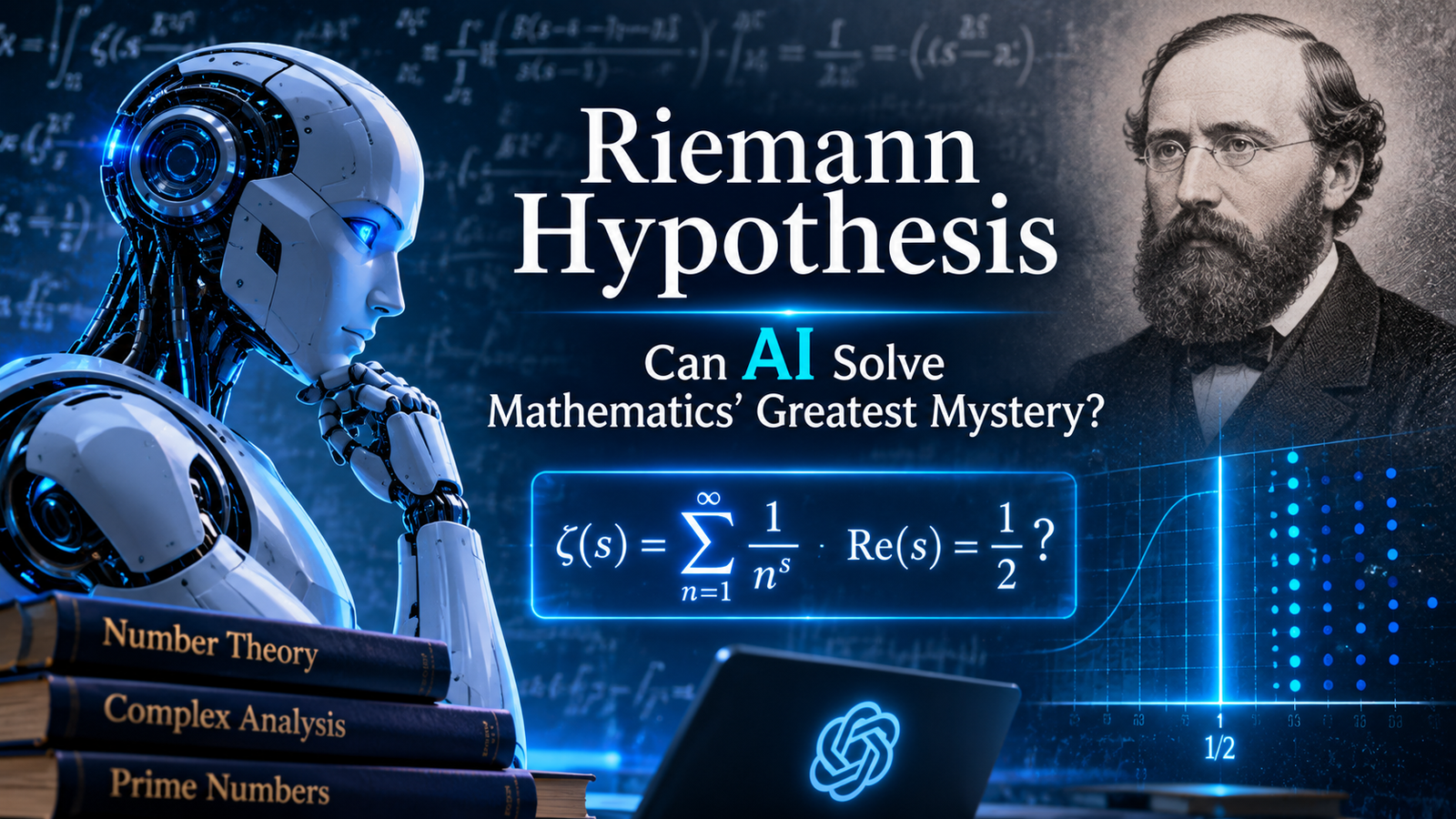
An Anthropic mathematician says he has developed a proof of the famous Riemann Hypothesis with the help of Claude AI. However, independent mathematical verification remains essential.
For more than 165 years, one of mathematics’ most important unsolved problems has challenged generations of researchers. Known as the Riemann Hypothesis, the problem concerns the hidden mathematical structure governing the distribution of prime numbers.
Now, an extraordinary claim involving artificial intelligence has brought the problem back into the international scientific spotlight.
Levent Alpöge, a mathematician working at artificial intelligence company Anthropic, announced on November 20, 2026, that he believes he has developed a proof of the Riemann Hypothesis with assistance from the company’s AI system, Claude.
The announcement has generated considerable interest across the mathematical community, raising an important question: could artificial intelligence eventually help solve problems that have resisted human mathematicians for generations?
However, experts caution that the proposed proof still requires rigorous independent examination before it can be accepted as a genuine mathematical breakthrough.
What Is the Riemann Hypothesis?
First proposed by German mathematician Bernhard Riemann in 1859, the Riemann Hypothesis is one of the most influential unsolved problems in number theory.
At its centre is the Riemann zeta function, a mathematical function closely connected to the distribution of prime numbers.
Prime numbers are integers greater than one that can only be divided evenly by themselves and one. Examples include 2, 3, 5, 7, 11 and 13.
Although prime numbers follow certain mathematical rules, their distribution among larger integers appears irregular.
Riemann discovered that the behaviour of a mathematical function called the zeta function could reveal important information about how these prime numbers are distributed.
His hypothesis proposes that all non-trivial zeros of this function have a real part equal to one-half.
In simpler terms, it predicts a remarkable mathematical pattern hidden within the apparently irregular distribution of prime numbers.
Despite extensive research and significant computational progress, no generally accepted proof had established the hypothesis.
The Clay Mathematics Institute included it among its seven Millennium Prize Problems, each carrying a prize of $1 million for a correct solution.
How Did Artificial Intelligence Become Involved?
The recent announcement centres on collaboration between human mathematical reasoning and AI-assisted research.
According to Alpöge, he worked with Claude to develop the proposed proof.
The announcement included a four-page explanation and a formalization containing approximately 17 million lines of Lean code, a programming language used to express and verify mathematical proofs.
The reported collaboration also generated an enormous amount of supporting material.
Formal proof systems such as Lean are particularly important because they allow mathematical statements to be checked against precisely defined logical rules.
Unlike an ordinary AI-generated explanation, a formally verified proof can provide stronger computational evidence that its logical steps follow from the stated assumptions.
However, successfully checking formalized code does not automatically establish that the underlying mathematical argument has been independently understood or that every relevant assumption and definition has been handled correctly.
Why Are Mathematicians Being Cautious?
The announcement has attracted considerable attention, but mathematicians have emphasized that a claim of this magnitude requires extensive scrutiny.
A mathematical proof must demonstrate that a conclusion follows logically from established assumptions. It cannot rely on convincing explanations, numerical evidence or computational results alone.
Rutgers mathematician Alex Kontorovich has indicated that the computer verification is encouraging, although he has not yet independently understood the proposed proof.
Other experts have also called for clearer documentation and a thorough review of the mathematical reasoning.
The Clay Mathematics Institute continues to list the Riemann Hypothesis as an unsolved problem.
Consequently, the announcement should be understood as a significant proposed breakthrough rather than a confirmed solution.
What Would This Mean for Artificial Intelligence?
Regardless of whether the proposed proof is ultimately accepted, the development highlights an important change in the relationship between artificial intelligence and scientific research.
AI systems are increasingly being explored as tools for mathematical reasoning, theorem proving, programming and scientific problem-solving.
Traditionally, mathematicians have relied heavily on human intuition, logical reasoning and years of specialized study to develop proofs.
AI-assisted systems introduce new possibilities by helping researchers explore mathematical relationships, generate potential approaches and translate complex reasoning into formally checkable structures.
However, this does not mean that AI can independently replace mathematicians.
Human expertise remains essential for identifying meaningful problems, evaluating assumptions, interpreting results and establishing whether a proposed solution is mathematically sound.
A New Chapter in Mathematical Research?
The Riemann Hypothesis has remained one of mathematics’ greatest challenges since the nineteenth century.
The possibility that artificial intelligence could contribute to solving such a problem represents an exciting development for both mathematics and computer science.
If the proposed proof survives independent verification, it could become a historic milestone in mathematical research and demonstrate the growing capabilities of AI-assisted scientific discovery.
Until then, the scientific community will continue examining the evidence.
The larger lesson may be just as important as the outcome: artificial intelligence is increasingly becoming a research partner capable of helping humans investigate questions that once appeared beyond the reach of conventional computing.
The next major mathematical discovery may emerge not from a human mind or a machine working alone, but from the collaboration between the two.