
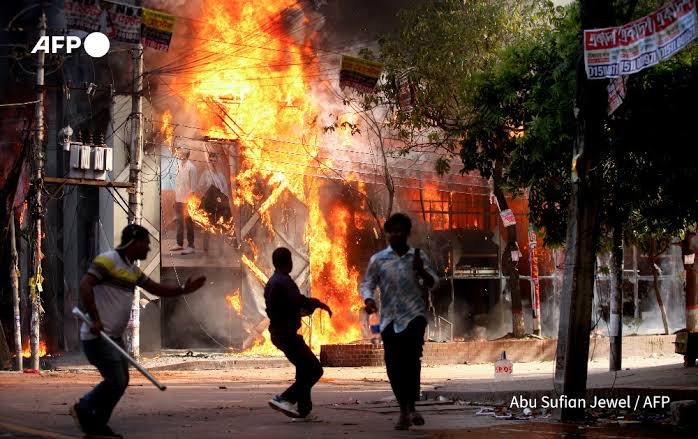
Bangladesh has been rocked by violent protests, arson attacks and bomb explosions as supporters of former prime minister Sheikh Hasina mobilise against the government ahead of her planned return from exile in India next month.
Parts of the country were shut down on Thursday following a nationwide protest and lockdown call by Hasina’s banned Awami League party. The demonstrations triggered clashes, attacks on public property and heightened security concerns across several districts.
In one of the most serious incidents, unidentified attackers set fire to the ancestral home of Nobel Peace Prize laureate Muhammad Yunus in Chattogram, police said. Yunus led Bangladesh’s interim government after Hasina was removed from power in August 2024.
Police said the fire broke out late Wednesday in an unused ground-floor room. Authorities extinguished the blaze, and no casualties were reported.
The unrest has also involved attacks on police stations, vehicles, homes and businesses. Police reported dozens of crude bomb explosions and vehicle arson incidents across at least 28 districts during the preceding 10 days.
Two activists of the ruling Bangladesh Nationalist Party (BNP) were reportedly killed during the violence, while authorities arrested more than 100 people in connection with alleged sabotage and unrest.
Security forces deployed
The government has intensified security operations, deploying 97 platoons of the Border Guard Bangladesh across seven districts, including Gopalganj and Faridpur, where Hasina’s supporters have a significant presence.
Police have also arrested former education minister Nurul Islam Nahid, who faces allegations relating to killings during the 2024 uprising.
Grameen Bank, founded by Yunus, has reported attacks on dozens of its branches and offices since November 10. The attacks have further heightened concerns about the safety of public institutions and businesses.
Bangladesh’s government has accused Awami League figures operating from abroad of encouraging violence to destabilise the country. The party’s leaders have been largely unavailable for comment.
Hasina vows to return from India
Hasina, 79, fled Bangladesh on August 5, 2024, following a student-led uprising that ended her 15-year rule. She has since been living in neighbouring India.
The former prime minister has announced plans to return to Bangladesh in December and has sought new travel and identity documents to facilitate her return. However, authorities have rejected her request.
Her planned return comes amid serious legal challenges. A Bangladeshi tribunal sentenced her to death in absentia in November 2025 after convicting her of crimes against humanity over the deadly crackdown on protesters during the 2024 uprising.
The United Nations estimated that up to 1,400 people may have been killed during the crackdown between July and August 2024.
Hasina has rejected the accusations and questioned the legitimacy of the legal proceedings.
Political tensions threaten stability
The latest unrest presents a major challenge for Bangladesh’s political leadership as the country continues to deal with the consequences of the 2024 uprising and the subsequent political transition.
Prime Minister Tarique Rahman has also accused India of involvement in developments surrounding the political crisis, adding another dimension to tensions between Dhaka and New Delhi.
With Hasina signalling her intention to return despite the death sentence against her, Bangladesh faces growing uncertainty over its political stability, public security and the future of its banned former ruling party.
Authorities have warned that those responsible for attacks and violence will face prosecution as security operations continue.