

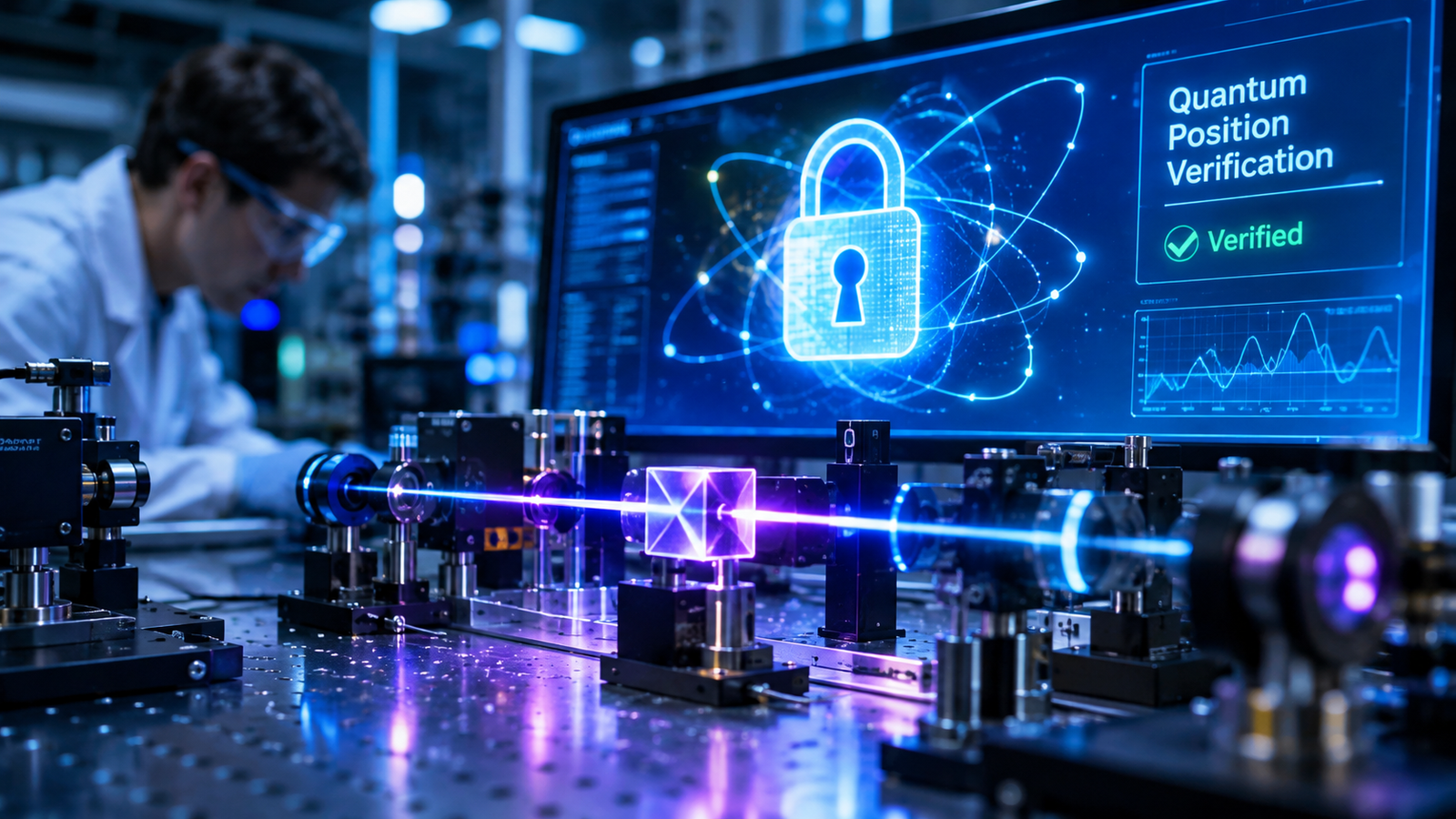
Researchers use quantum entanglement to verify a person’s physical location, opening a potential new frontier in digital security.
For decades, cybersecurity specialists have relied on passwords, encryption and digital authentication systems to protect sensitive information. However, as cyberattacks become increasingly sophisticated, a fundamental challenge remains: how can a computer system know whether the person requesting access is actually where they claim to be?
Scientists may have found an entirely new approach to addressing this problem — by using the principles of quantum physics.
Researchers from the US National Institute of Standards and Technology (NIST), alongside international collaborators, have demonstrated an experimental technique that uses quantum entanglement to verify the physical location of an individual. The research, published in the scientific journal Nature on November 18, 2026, represents an important step towards connecting digital security with physical location verification.
How Does Quantum Physics Help Prevent Hacking?
Quantum entanglement occurs when two particles become connected in such a way that measuring one particle reveals information about its partner, even when the particles are separated by considerable distances.
In the experiment, researchers generated pairs of entangled photons — particles of light — and used them to establish a system capable of checking whether a participant was physically present at a claimed location.
Two verification stations were established approximately 195 metres apart at the NIST research facility in Boulder, Colorado. These stations sent carefully timed, random information to a participant positioned between them.
The participant had to measure the polarization of an incoming photon and report the result. By examining the response time and comparing the measurements with their own entangled photons, the researchers could determine whether the participant was genuinely located in the expected position.
The experiment also incorporated a loophole-free Bell test, which helped establish that the observed quantum correlations could not be explained through ordinary classical physics.
Why Is This Important for Cybersecurity?
Traditional digital authentication systems generally establish identity through credentials, devices or biometric information. However, these methods do not necessarily prove that someone is physically present at an authorized location.
For example, a cybercriminal could potentially impersonate an employee through a remote connection or manipulate conventional location-verification systems.
Quantum position verification introduces a different security approach. Rather than relying exclusively on digital credentials, it uses quantum measurements and the fundamental limitations of quantum information to establish physical presence.
According to NIST, the technique could eventually have applications in protecting financial transactions, securing healthcare records and preventing unauthorized access to critical infrastructure.
It may also provide an additional layer of protection against certain forms of remote impersonation and phishing attacks.
The Technology Is Still Years Away.
Despite the promising results, the researchers emphasize that the technology is not ready for widespread commercial deployment.
Building practical quantum communication networks requires highly reliable equipment capable of generating, transmitting and detecting individual photons with exceptional precision.
The experimental system also relied on specialized detectors and carefully controlled laboratory conditions.
NIST researchers estimate that real-world applications could still be more than a decade away.
Nevertheless, the experiment demonstrates that quantum mechanics may offer cybersecurity capabilities that conventional technologies cannot easily reproduce.
The Future of Digital Security.
As financial institutions, governments and businesses become increasingly dependent on interconnected digital infrastructure, verifying not only who is accessing a system but also where they are accessing it from could become increasingly important.
Quantum position verification remains an emerging research field, but its successful experimental demonstration represents a significant scientific milestone.
The future of cybersecurity may not depend exclusively on stronger passwords or more sophisticated encryption. It could also involve using the fundamental laws of physics to establish trust in the digital world.