

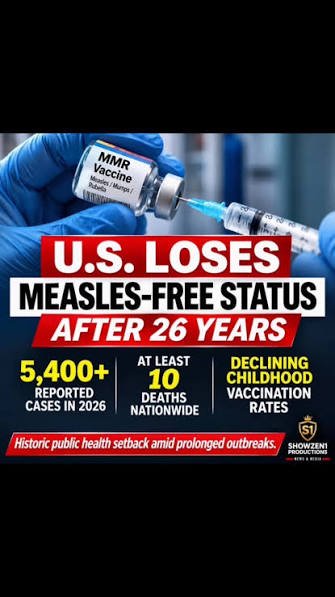
The United States has lost its measles elimination status after 26 years, marking a major public health setback as sustained outbreaks have brought back a highly contagious disease that the country had successfully eliminated in 2000.
The Pan American Health Organization (PAHO), the regional office of the World Health Organization (WHO), announced on November 17 that the United States no longer meets the criteria for measles elimination because the same virus lineage has continued circulating uninterrupted for more than 12 months.
Mexico and Bolivia have also lost their measles elimination status, reflecting a wider resurgence of the vaccine-preventable disease across the Americas.
According to PAHO, the decision followed an assessment by its regional commission on measles and rubella elimination, which reviewed the epidemiological situation during a meeting held from November 10 to 13.
The United States had maintained its measles elimination designation since 2000, following extensive vaccination campaigns and effective public health surveillance. Pan American Health Organization+2
More than 7,700 infections reported since 2025
The resurgence has been particularly severe, with approximately 7,700 measles infections and 13 deaths reported in the United States since the beginning of 2025, according to Reuters.
The country is experiencing its highest number of measles cases in more than three decades, with most infections involving people who were not vaccinated.
The outbreak has affected multiple states, including Texas, South Carolina, Utah, Pennsylvania and Wisconsin, placing additional pressure on public health authorities.
Measles is among the world’s most contagious infectious diseases. One infected person can transmit the virus to as many as 18 susceptible individuals, making outbreaks particularly difficult to control in communities with low vaccination coverage. Reuters+2
Declining vaccination rates blamed for resurgence
Health experts have identified declining childhood vaccination coverage and growing vaccine hesitancy as major factors behind the resurgence.
According to the US Centers for Disease Control and Prevention (CDC), measles, mumps and rubella (MMR) vaccination coverage among American kindergarten children fell from 95.2 per cent in the 2019–2020 school year to 92.7 per cent in 2023–2024.
Public health authorities generally recommend at least 95 per cent vaccination coverage to maintain community protection against measles.
The decline has left increasing numbers of children and adults vulnerable to infection, particularly in communities where vaccination rates have fallen substantially.
The CDC has also identified disruptions to routine childhood immunisation during the COVID-19 pandemic as a contributing factor.
Vaccine misinformation and declining public confidence in healthcare institutions have added to the challenge.
What losing measles elimination status means
Measles elimination does not mean that a country has completely eradicated the virus or will never record another infection.
Instead, the designation means that continuous transmission of a particular measles virus strain has been interrupted for at least 12 months.
Under PAHO criteria, a country loses its elimination status when the same virus genotype and lineage continue circulating uninterrupted for 12 months or longer.
The United States’ loss of designation therefore indicates that measles has become re-established as an endemic disease rather than remaining limited to occasional imported cases and short-lived outbreaks.
PAHO Director Jarbas Barbosa described the development as a serious setback, warning that prolonged transmission exposes families and communities to preventable illness, hospitalisation and death.
CDC pledges to restore elimination status
The US Centers for Disease Control and Prevention has pledged to work with state and local health departments to contain outbreaks and restore the country’s measles elimination status.
In a statement issued on November 17, the CDC said it would strengthen vaccination programmes, improve disease surveillance and expand access to immunisation.
The agency also disclosed that approximately $100 million in additional funding had been provided to support prevention and response activities against measles and other vaccine-preventable diseases.
US health authorities have emphasised that vaccination remains the most effective protection against measles.
Two doses of the MMR vaccine provide approximately 97 per cent protection against the disease. CDC Newsroom+1
Mexico and Bolivia also lose elimination status
The United States is not the only country facing a reversal in its measles elimination achievement.
PAHO confirmed that Mexico and Bolivia had also lost their designation after sustained transmission of the virus for more than 12 months.
The development has weakened the Americas’ regional efforts to eliminate measles.
The region had regained its measles elimination status in 2024 after interrupting endemic transmission in Venezuela and Brazil. However, Canada lost its status in November 2025, followed by the latest setbacks involving three additional countries.
PAHO reported 58,213 confirmed measles cases and 82 deaths across the Americas as of November 13, 2026, compared with 12,806 cases during the corresponding period in 2025.
The organisation has urged governments to strengthen childhood immunisation, improve disease surveillance and respond rapidly to outbreaks.